Digital Camera With Flash: Why Direct Flash Makes the Look
The DayRoll TeamThe short answer: the flash is doing most of the work. A bright light sitting right next to the lens produces a lit subject, a dark background and hard shadows, and that combination is what makes a photo read as a night out rather than a record of one. Phones spend enormous effort avoiding this. Retro cameras lean into it, which is why a cheap camera can produce a photo that feels better than a technically superior one.
We build cameras around this, so we would say that. The physics below is checkable by anyone with any camera.
How does a camera flash work?
A flash fires a very short, very bright burst of light at the moment the shutter opens. Two consequences follow, and they explain everything about the look.
First, light falls off sharply with distance. Something one metre away receives dramatically more light than something three metres away. That is why the subject is bright and the room behind them goes dark, even when the room was not dark at all.
Second, the flash sits next to the lens, so the light hits the subject almost straight on. Straight on light flattens faces and removes the gentle shading that makes a portrait look sculpted. It is objectively unflattering, and it is also the entire aesthetic.

Why your phone avoids all of this
A modern phone would rather do almost anything than fire a hard flash. It will stack several frames, brighten the shadows, reduce noise and reconstruct the scene, all to give you an evenly lit photo that looks like the room felt to your eyes.
That is a genuine engineering achievement. It also removes the contrast between subject and background that makes a flash photo look like a specific moment. You get a good record and a forgettable image.
Direct flash versus what your eyes saw
| Direct flash | Phone night mode | |
|---|---|---|
| Subject | Bright, sometimes too bright | Evenly exposed |
| Background | Falls into darkness | Recovered and visible |
| Shadows | Hard edged | Softened or removed |
| Grain | Left in | Removed |
| Feels like | A moment | A room |
| Best at | People, close, indoors | Landscapes and low light detail |
How to use flash on purpose
- Get closer than feels natural. Flash falls off fast. At one to two metres it works. At five it lights nothing and wastes the shot.
- Force it on in daylight. This is the trick most people never try. Outdoors on a bright day, flash fills the shadows under eyes and separates the subject from the background. It is where the technique earns its keep.
- Do not fight the dark background. It is not a mistake, it is the look. If you want the room to be visible, that is a different photo and a different camera.
- Shoot more than one. Flash photos of people fail often, and the third frame is usually the good one.
- Avoid glass and mirrors straight on. A direct flash into a window comes back as a white disc.

What to look for in a camera with flash
The distinction that matters is between a genuine flash and a small continuous LED light. An LED is fine for illuminating something a metre away in a dark room, but it does not produce the falloff or the freeze that creates the look. If a listing avoids the question, that usually is the answer.
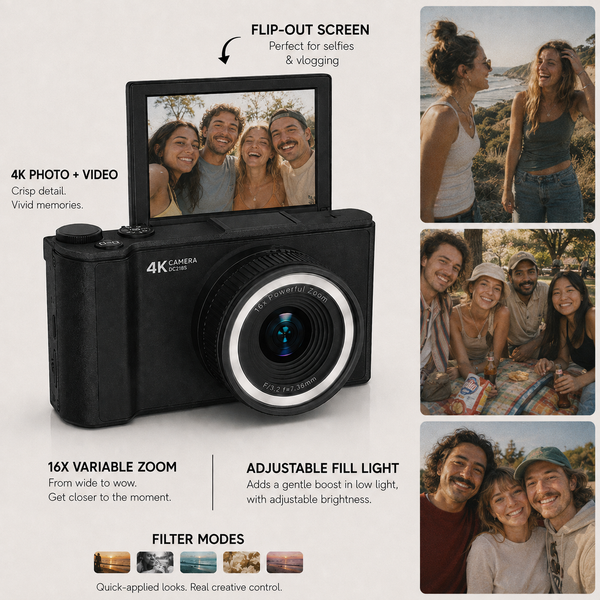
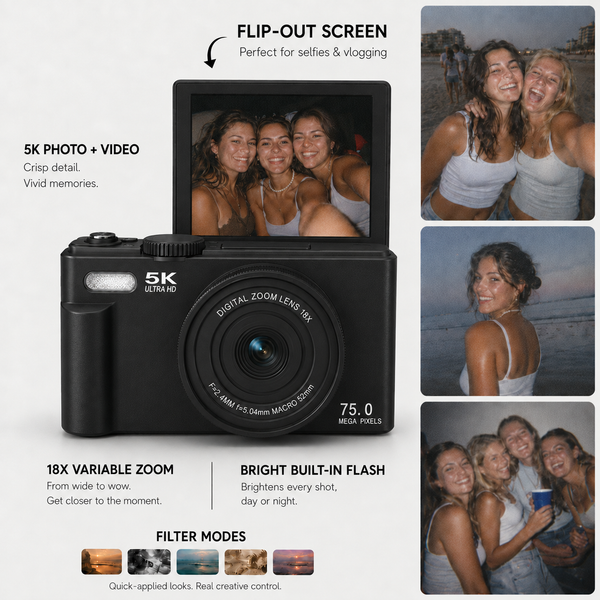
So we will answer it about our own two. Only the Q6 Max has a true built in flash, and that is what it is for. It comes in Black, Pearl or Pink. The Q5 DigiCam uses an adjustable LED fill light instead: continuous light rather than a burst, which lifts a subject close up indoors and at night but does not produce the hard falloff described above. If the direct flash look is the reason you are buying, buy the Q6 Max. If you want the warm, grainy, low fi early 2000s picture and a smaller, simpler camera, the Q5 is the one.
Where flash is the wrong tool
- Anything further than a few metres away
- Landscapes and cityscapes at night, where a phone will beat it comfortably
- Concerts and venues where flash is not permitted or is simply rude
- Photographing artwork, glass or anything reflective straight on
In our customers’ words
“Second DayRoll camera and I’m loving it. The flash is perfect for girls’ nights out, and it’d make such a cute Chrissy gift!”
Monique H., review of the Q6 Max
Questions we get asked
Why do flash photos look bad on me?
Direct flash is unflattering by design. It flattens and it is unforgiving. The trade is that it makes photos look alive rather than composed, which is why people accept it.
Can I recreate this in editing?
You can approximate the colour and add grain. You cannot easily fake the falloff, because that is a property of where the light was when the photo was taken.
Does using the flash drain the battery quickly?
It uses more power than shooting without it. Both of our cameras charge over USB, so a power bank covers a long night.
Is there a way to soften it?
On the Q6 Max, moving slightly further back or shooting at an angle rather than straight on both help. The Q5 DigiCam does not have this problem in the same way, because its adjustable LED fill light is continuous and softer than a flash burst to begin with.
If you want the wider context, read what is a digicam or why digicam photos feel different to phone photos.