Digicam vs Phone: Why the Photos Feel So Different
The DayRoll TeamThe short answer: your phone takes a technically better photo and a digicam takes a more memorable one. A phone runs every shot through heavy processing that removes noise, evens out the light and corrects skin. A digicam does almost none of that, so what you get is closer to what the room actually looked like: warm, a bit rough, a bit blown out by the flash.
Neither is wrong. They are solving different problems. Your phone is trying to give you a clean record. A digicam is trying to give you a photo with a mood.
What your phone is actually doing
A modern phone photo is not one photo. The moment you tap the shutter, the phone stacks several frames, reduces noise, lifts the shadows, pulls back the highlights, sharpens edges and smooths skin. It happens in a fraction of a second and you never see it.
The result is remarkable and also slightly strange. Every photo comes out evenly lit and correct, which is why photo dumps from a night out increasingly look the same. Grain is gone. Contrast is gone. The specific ugliness of a kitchen light at 1am is gone, and that ugliness was half the memory.

What a digicam does instead
- One frame, not twenty. What the sensor saw is what you get.
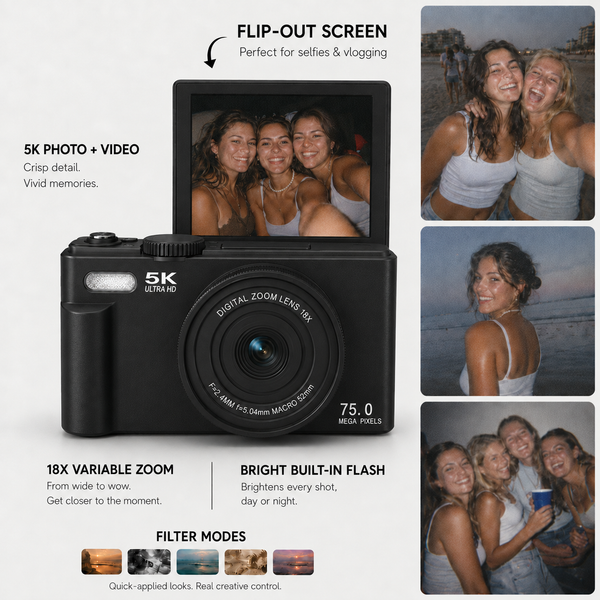
- A hard flash near the lens. Bright faces, dark background, strong shadows. It is the single biggest reason the photos read as a night out rather than a document.
- Noise stays in. Grain is not removed, so photos have texture instead of a smooth plastic surface.
- Colours drift. Warm indoors, a little cool at dusk, not corrected to neutral.
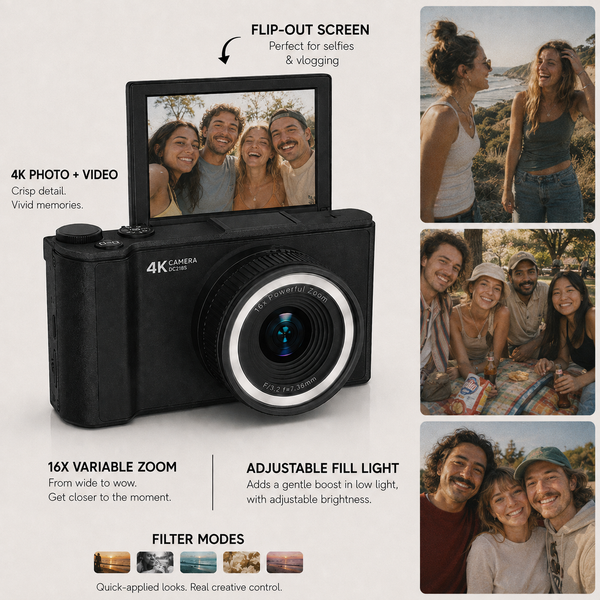
That is the whole design goal of the Q5 DigiCam: keep the character in, leave the correcting to somebody else.
Side by side
| Phone | Digicam | |
|---|---|---|
| Processing | Heavy, automatic | Almost none |
| Grain | Removed | Left in |
| Flash | Soft, often avoided | Hard and direct |
| Photos look | Clean and consistent | Warm and imperfect |
| Best at | Recording what happened | Recording how it felt |
| The catch | Everything looks the same | Not every shot works |
The part nobody mentions: what happens socially
There is a second difference that has nothing to do with sensors. When you pull out a phone at a table, people check themselves. It is a phone, so it might be a story, it might be a post, it might be a screenshot in a group chat.
Hand someone a small camera and the reaction changes. They pose worse, laugh more, and stop managing the image. You can see it in the photos. It is not a technical advantage, but it is the reason a lot of people end up preferring the results.
Where your phone still wins, clearly
- Very low light without flash
- Anything that needs to be sharp: documents, signs, a whiteboard
- Video you plan to actually edit
- Photos you need to send within thirty seconds
We are not going to tell you to leave your phone at home. Take both. They do not compete.

In our customers’ words
“Love this little camera. I keep it in my bag and actually take photos now instead of using my phone for everything.”
Emily C., review of the Q6 Max
Questions we get asked
Can I not just use a filter app?
You can get close to the colour. You cannot easily fake the flash falloff, the lens softness or the real grain, because those happen at the moment of the shot. And in practice, almost nobody goes back and edits the photos.
Are the photos lower resolution than my phone?
Different, not simply lower. If resolution is what you want, the Q6 Max shoots at up to 75MP. But resolution was never why these photos look the way they do.
Will they look good on Instagram?
That is where the look started. Compression on social platforms tends to flatter grain rather than fight it.
Is it annoying to carry two things?
It is pocket sized and it lives in a bag. Realistically you notice it twice a night, both times because someone asks to hold it.
If you want to see the difference on your own nights out, the Q5 DigiCam is the simplest way in, and the full range is here.