Digital Camera vs Film Camera: Which Should You Actually Buy?
The DayRoll TeamThe short answer: film gives you genuine analogue photographs, an ongoing cost and a wait. Digital gives you a similar visual character straight away, for free after the camera, with no developing. If what you want is film, buy film, and we will say that plainly. If what you want is the look and feel of those photos without the process, a digital camera gets you most of the way there and you can shoot hundreds of frames finding out.
We sell digital cameras. So the useful thing we can do here is be honest about what film does that we cannot.
What actually looks different?
Less than people expect, and in specific places.
Most of what reads as "film" in a photo is not the film itself. It is the hard on camera flash, the small simple lens, the lack of noise reduction and the absence of any editing. Those things exist independently of the medium, which is why a compact digital camera can produce photos that feel very close.
Where film is genuinely different is in how it handles extremes. Highlights roll off more gently, so a bright window behind someone degrades more pleasantly. Grain is structured rather than digital noise. And colour shifts in ways specific to each stock. Those differences are real. They are also subtler than the internet suggests, and mostly invisible on a phone screen.

The difference that actually changes your life
It is not image quality. It is the loop.
With film you shoot a limited number of frames, then you stop, then you pay, then you wait, then you see. That loop is slow and expensive, and for a lot of people that is exactly the appeal: it forces you to think before pressing the shutter, and the wait makes the photos feel like an event.
With digital the loop is closed the same night. That means you shoot more, you experiment more, and you learn faster. It also means you feel it less. Nobody gets excited about opening a folder.
Neither is better. But be honest with yourself about which loop you actually want, because that decides whether you keep shooting after month three.
Side by side
| Film camera | Digital camera | |
|---|---|---|
| The look | Genuine analogue grain and colour | Very close, especially with flash |
| Cost after buying | Film and developing, every time | None |
| When you see the photos | After developing | Immediately |
| Frames per outing | Limited, and you feel it | Effectively unlimited |
| Learning speed | Slow, because feedback is delayed | Fast, because you see the mistake |
| The ritual | Real, and it is the point for many people | Almost none |
| Failure mode | A whole roll can be lost | You just delete it |
When we would tell you to buy film
- You want the ritual. Loading, winding, waiting, collecting. No digital camera reproduces that and none should try.
- You want to slow down. A hard limit of frames changes how you shoot in a way no setting can.
- You want an object. Negatives are a physical archive. Files are not.
- You already know you love it. If you have shot film and missed it, nothing digital will scratch that itch.
We would rather you spent your money on the right thing than bought from us and felt vaguely disappointed.
When digital is the better answer
- You want the look without an ongoing cost every time you go out
- You want to shoot a lot, including badly, while you work out what you like
- You want the photos the same night to share or print
- You are buying it for someone else and cannot rely on them keeping up a film habit
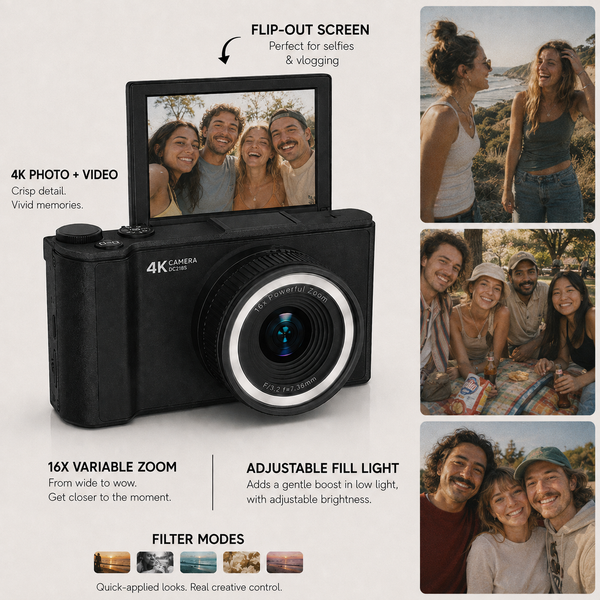
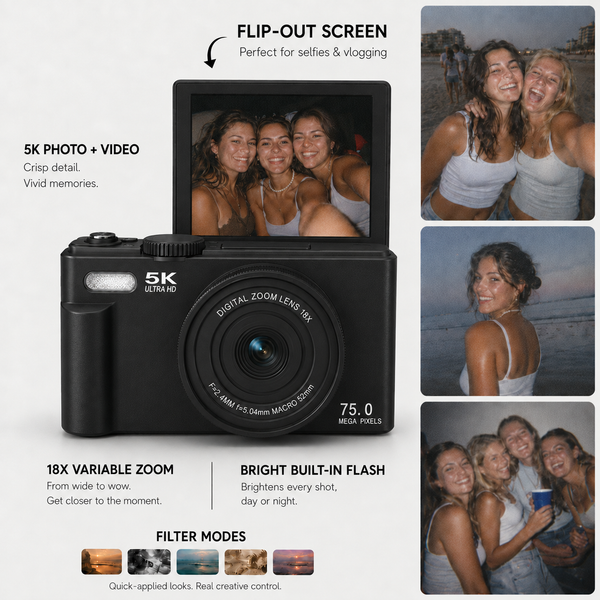
That is the space our cameras sit in. The Q5 DigiCam is the simplest way in, and the Q6 Max adds a true built-in flash, more resolution and reach for longer trips.
What about disposables?
A single use camera is a film camera with the decision removed. It still involves developing and a wait, and you get one roll. It makes most sense as an event object, left on a table for other people to use, rather than as a camera you own. We wrote about that trade off in more detail in digicam or disposable.

Honest limits on our side
A compact digital camera is at its best in decent light and up close with flash. It will not give you the highlight behaviour of film, and it will not give you negatives. If either of those is what you are chasing, we are not the answer and no amount of marketing changes that.
In our customers’ words
“Great pics and product”
Belinda Z., review of the Q5 DigiCam
“Easy, fast, convenient”
Rachel F., DayRoll store review
Questions we get asked
Is digital cheaper than film in the long run?
Yes, and it is not close. You pay once for the camera and nothing after. With film you pay every roll, forever.
Can a digital camera really look like film?
It can look close, particularly with flash indoors and at night. It is not film and we do not claim it is. We explain what creates the resemblance in what is a digicam.
Should a beginner start with film?
Only if the ritual is the appeal. Feedback is delayed and every mistake costs money, which is a slow way to learn. Our beginner guide covers the alternative.
Can I get prints from a digital camera?
Yes. Our Pocket Printer prints in about a minute with no ink or cartridges, so you can have something physical without a lab.
If digital is where you land, the whole range is here. Free tracked shipping to Australia and New Zealand.